
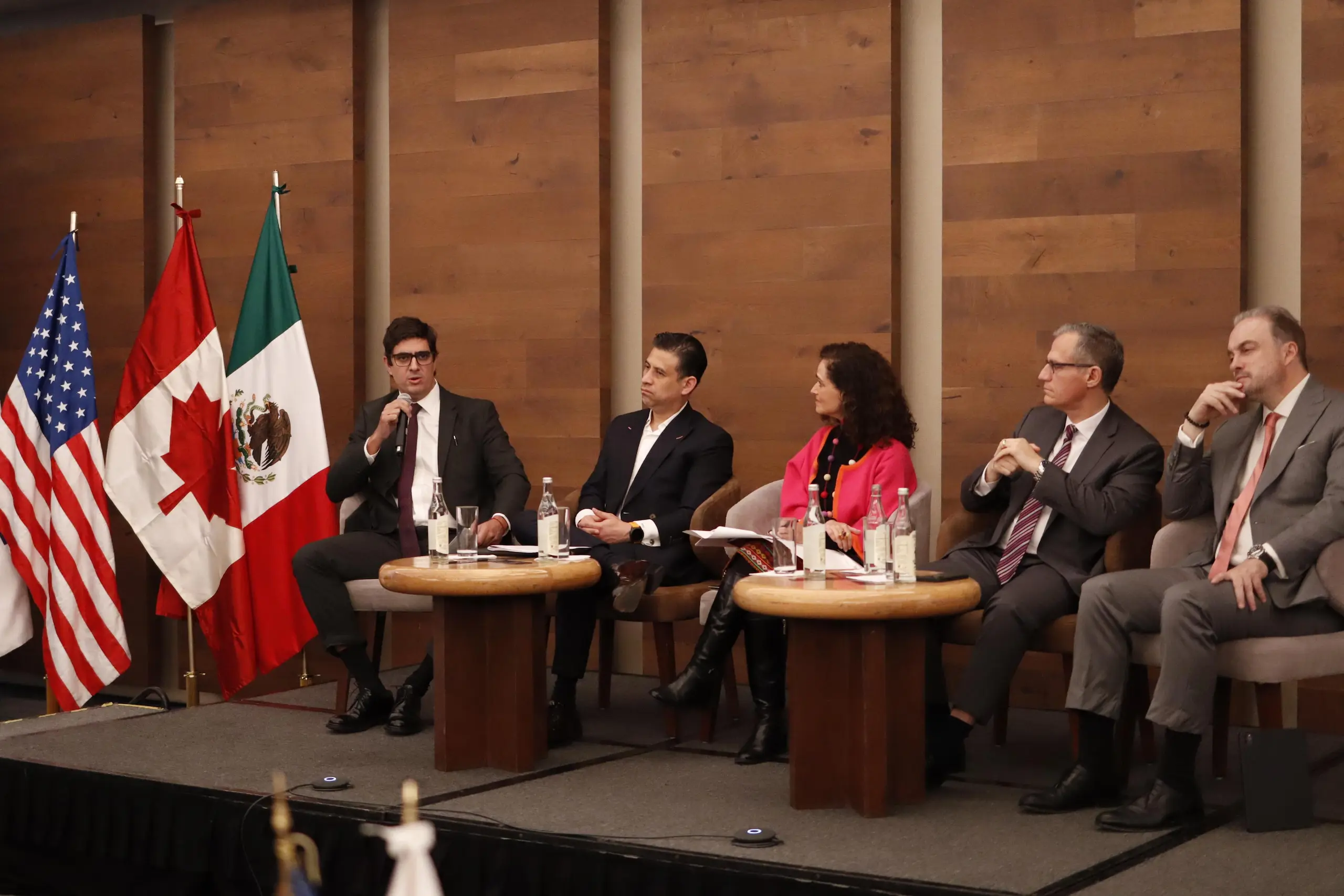
Business leaders, specialists and representatives of strategic organizations gathered at a forum convened by the Mexican Business Council for Foreign Trade, Investment and Technology (COMCE) to analyze the challenges and opportunities that will shape the review of the United States–Mexico–Canada Agreement (USMCA) scheduled for 2026, as well as the potential effects of tariff pressures across the region.
During the meeting “Mexico on the Road to the USMCA Review and the Impact of Tariffs,” COMCE Executive President Sergio E. Contreras Pérez underscored North America’s strategic importance in the global economy and called for strengthening a shared vision among the three countries.
Contreras Pérez noted that USMCA accounts for nearly 30 percent of global GDP, with regional trade totaling $1.93 trillion, a 37 percent increase compared with 2020, and a 23 percent rise in regional foreign direct investment compared with the previous year.
In this context, he said, Mexico, the United States, and Canada must deepen the integration built over more than three decades.
Former U.S. Ambassador Roberta S. Jacobson warned that the agreement’s review will be decisive in defining the region’s future. She said Mexico must take advantage of the institutional mechanisms within the bilateral relationship to navigate a complex environment, while emphasizing that the country is a key partner for U.S. global competitiveness.
On bilateral negotiations, Kenneth Smith Ramos, president of COMCE’s Mexico–United States Bilateral Committee, said Mexico must maintain a firm stance in the face of potential tariff pressures, noting that it is the main destination for U.S. exports. He added that technical strength and responsiveness will be decisive factors in the review process.
From the energy sector, Juan Acra, president of the Mexican Energy Council, pointed to the need for a comprehensive policy that strengthens regional energy security and ensures investment in infrastructure. In the legal sphere, Mario Valencia, a partner at Galicia Abogados, explained that the USMCA review will be a technical process focused on compliance with environmental, energy and labor commitments.
In strategic industries, Antonio Ortiz Mena, president of COMCE’s USMCA Committee, said North America has the conditions to move toward self-sufficiency in steel and aluminum through greater trilateral coordination.
Armando Ortega, president of COMCE’s Mexico–Canada Bilateral Committee, highlighted the opportunity to promote a Critical Minerals chapter to secure the regional supply chain, which is key to the energy transition, artificial intelligence, high technology and national security.
The automotive sector was also identified as a strategic pillar. Francisco González Díaz, executive president of the National Auto Parts Industry, stressed that Mexico maintains an indispensable role as a supplier to U.S. automakers, a strong point that should be reflected in the country’s negotiation strategy.
From the organization’s international perspective, Juan Pablo Cervantes Sánchez Navarro, president of COMCE’s North America International Section, said regional competitiveness will depend on deepening integration and building a common agenda that transforms the USMCA review into a structural opportunity.
Representing the federal government, Ismael Ortiz, head of the Global Economic Intelligence Unit at Mexico’s Ministry of Economy, said the country enters the process from a position of strength due to its industrial capacity, innovation ecosystem, and competitive talent, elements that will help reinforce certainty and trade fairness.
The meeting also included representatives from the Business Coordinating Council, the Mexican Institute for Competitiveness, the Mexican Business Council, the financial sector and customs brokers, among other key foreign trade stakeholders.
The forum concluded with a call to strengthen regional and business coordination to turn the challenges of the USMCA review into long-term advantages. COMCE reiterated its commitment to supporting Mexico’s private sector, promoting foreign trade, attracting investment and fostering innovation toward 2026.
Related: Ebrard Foresees Record Growth for Mexico with the 2026 USMCA Review