
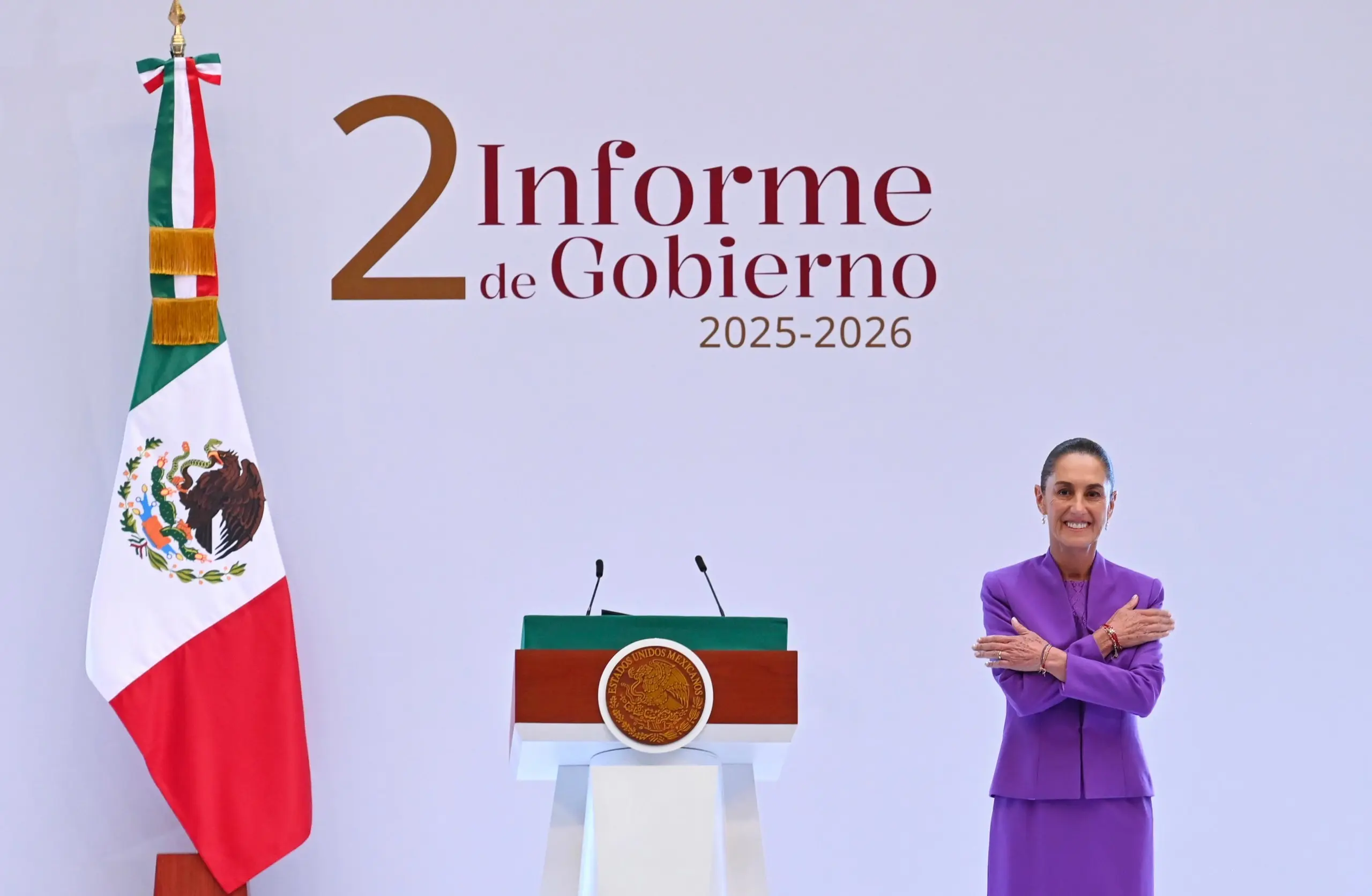
“Sovereignty is not negotiable, it is not surrendered and it is not shared,” President Claudia Sheinbaum said during her Second Government Report, in which she defended a relationship based on dialogue with the United States, rejected any form of subordination, and pledged to protect Mexicans living abroad.
Speaking from the National Palace, the president acknowledged that relations with the U.S. government have faced difficulties and described the treatment of Mexican migrants as one of the most painful episodes, including the deaths of 17 Mexican nationals in detention centers, and enforcement operations.
Sheinbaum said her administration filed complaints in cases where they were warranted and pledged to follow up on those proceedings to demand full respect for the human rights of Mexicans.
She also announced a transformation of consular services to simplify procedures and bring assistance closer to communities. Consuls, she said, are responsible for listening to the needs of Mexican nationals, supporting them and defending their rights.
Through the México Te Abraza (Mexico Embraces You) program, the government has assisted more than 281,000 people who returned from the United States by providing food, transportation to their communities, medical and psychological care, and identification documents.
On trade, a strategic issue amid the review of the United States-Mexico-Canada Agreement, Sheinbaum said there is an ongoing dialogue with Washington and expressed confidence that an understanding will be reached.
The president said Mexico has faced difficult international conditions because of changes in U.S. tariff policy, particularly duties imposed on vehicles, steel, aluminum and their derivatives.
Despite those pressures and the rise in international oil prices, she maintained that the Mexican economy remains stable and that her administration will continue seeking agreements without abandoning national interests.
On security, Sheinbaum said cooperation with the United States must be based on four principles: respect for sovereignty and territorial integrity, shared and differentiated responsibility, mutual respect and trust, and cooperation without subordination.
“Cooperation does not mean submission, and friendship does not mean abandoning our principles,” the president said before pledging to defend Mexico’s independence and dignity for as long as she remains head of the executive branch.
Presenting the results of the national security strategy, she said intentional homicides have declined 51 percent since she took office, equivalent to 44 fewer killings each day.
She added that July recorded the lowest daily average of homicides in the past 11 years and that, during 2026, the average number of high-impact crimes declined 54 percent compared with 2018.
From October 2024 through July 2026, she reported, 63,000 people linked to criminal activity were arrested, including 207 high-priority targets belonging to criminal organizations.
Authorities also seized 32,824 firearms and 519 tons of drugs, while dismantling 2,725 clandestine laboratories and sites used to produce methamphetamine, according to figures presented in the report.
On the economy, Sheinbaum reported $35 billion in foreign direct investment during the first half of 2026, an amount 12 percent higher than that recorded during the same period in 2024.
She also said the economy grew 1.9 percent during the second quarter compared with the same period in 2025, while the country reached 60 million employed people and an unemployment rate of 2.7 percent.
The president said the peso remains close to 17 per dollar, that the prices of regular gasoline and diesel have not increased, and that 24 products in the basic food basket have declined in real cost by 12 percent.
Federal revenue reached 6.046 trillion pesos during 2025, approximately 487 billion pesos more than the previous year. By the end of August 2026, she added, accumulated revenue was 149 billion pesos higher than during the same period in 2025.
Sheinbaum highlighted that the monthly minimum wage increased from 2,800 pesos in 2018 to 9,282 pesos in 2026, representing real growth of 154 percent.
Along the northern border, the minimum wage has reached 13,409 pesos per month, while the average wage of formal-sector workers rose to 20,212 pesos. She also highlighted the gradual reduction of the workweek to 40 hours by 2030.
Social programs occupied another central part of the report. The president said they will reach 42,860,296 people across the country by the end of 2026.
Beneficiaries include 13.788 million older adults, 2.873 million women between the ages of 60 and 64 enrolled in Mujeres Bienestar, and two million people with disabilities.
On health care, she reported the completion and opening of 33 hospitals operated by IMSS, ISSSTE and IMSS-Bienestar, along with 11 family medicine units, 36 health centers and medical offices, and 650 operating rooms.
According to the report, the Health Care From Home program has conducted more than 23 million home visits to older adults and people with disabilities, with the participation of 20,000 health care professionals.
On education, Sheinbaum said 156,000 new upper-secondary education spaces will be created during 2026 through 485 construction and expansion projects. The goal for 2030 is to open 400,000 spaces and reach 90 percent nationwide coverage.
On housing, the federal government aims to build 1.8 million homes for families earning less than 2.9 times the minimum wage. So far, she said, contracts have been awarded for 668,000 homes, 278,000 are under construction and 90,000 have already been allocated.
The president also said five million families were freed from unaffordable loans through debt restructuring.
On infrastructure, she reported 88 percent progress in repaving the country’s 51,000 kilometers of toll-free federal highways and the construction of 70 bridges and highway interchanges during the first two years of her administration.
She also highlighted progress on the AIFA-Pachuca, Mexico City-Querétaro, Querétaro-Nuevo Laredo and Querétaro-Guadalajara passenger rail lines, as well as the Maya freight train and other railway projects in southern Mexico.
On energy, she said the debt of Petróleos Mexicanos was reduced by $20 billion and that the National Refining System processes more than 1.5 million barrels per day.
Sheinbaum concluded her Second Government Report with a message directed both inside and outside the country. She said Mexico will continue seeking cooperation, dialogue and understanding with other nations, but without giving up its sovereignty, dignity or independence.
Related: Sheinbaum confident in USMCA continuity despite Trump’s remarks