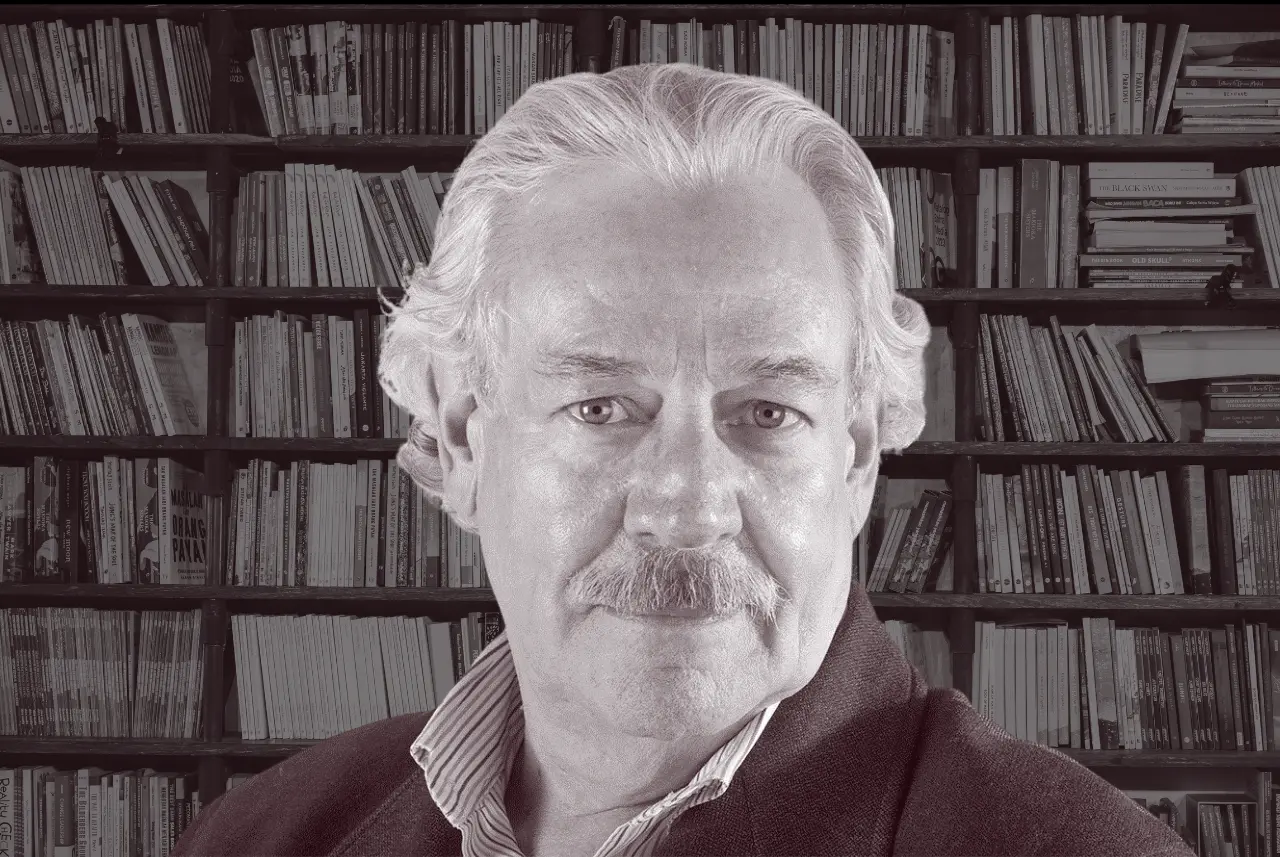
Mexican writer Gonzalo Celorio will receive the 2025 Cervantes Prize this Thursday, the highest recognition in Spanish-language literature, in a ceremony to be held at the Paraninfo of the University of Alcalá de Henares, in Spain.
The award, considered the most important in the Spanish-speaking world and bestowed with 125,000 euros, was granted for his “exceptional body of work,” in which the jury highlighted a literary voice of “notable elegance and reflective depth,” developed over more than five decades.
The ceremony will be presided over by the King and Queen of Spain, Felipe VI and Letizia Ortiz, as part of the central activities of World Book Day, an emblematic date for literature in the Spanish language.
A day earlier, during a luncheon at the Royal Palace in Madrid, King Felipe VI dedicated remarks to the Mexican author, highlighting his contribution to language and literature.
“Gonzalo Celorio highlights the Spanish language, to which he has devoted his life in nearly all possible facets, as a narrator, teacher, academic, essayist, and editor,” he said.
“A good book of memoirs is at once the story of a life and that of an era,” the monarch added, referring to That Heap of Broken Mirrors, the title with which Celorio pays tribute to Jorge Luis Borges.
Originally from Mexico City, Celorio has built a career that positions himself as a “complete writer: creator, teacher, and passionate reader,” whose work serves both as a record of modern Mexico and a reflection on the human condition.
Upon learning of the award, the author expressed his emotion at receiving a prize that honors his “love for the Spanish language” and his “devotion to Cervantes,” and emphasized that his work revolves around Mexican identity and its many influences, particularly Spanish.
Currently director of the Mexican Academy of Language, Celorio will become the seventh Mexican to receive the Cervantes Prize, joining a list that includes figures such as Octavio Paz, Carlos Fuentes, Sergio Pitol, José Emilio Pacheco, Elena Poniatowska, and Fernando del Paso.
His inclusion will also place him alongside major figures of world literature such as Mario Vargas Llosa and Miguel Delibes.
In his remarks, the King also underscored the role of literature as a tool of freedom. “Literature is ultimately a great school of freedom,” he said, inviting recognition not only of the author, but of the language shared by more than 600 million speakers.
In the days leading up to the ceremony, Celorio participated in various events, including depositing a legacy in the Cervantes Institute’s Vault of Letters and meeting with the monarchs at the Royal Palace in Madrid.
After receiving the prize, the author will be in charge of inaugurating the traditional Continuous Reading of Don Quixote at the Círculo de Bellas Artes, one of the most symbolic events of Cervantes Week.
Much of Celorio’s work revolves around memory, both personal and collective. Among his books are Self-Love and his family trilogy composed of Three Beautiful Cubans, The Metal and the Dross, and The Apostates, where he explores his Asturian and Cuban roots.
The author has also developed and written significant essays with titles such as The Underlinings Are Mine and Subversive Canons, as well as literary portraits in Gossip of Memory, where he reconstructs intimate views of figures such as Cortázar, Rulfo, and García Márquez.
Celorio’s most recent work, That Heap of Broken Mirrors, gathers first-person memoirs that trace his public life, intellectual training, and literary vocation.
With this recognition, Celorio not only consolidates his place in Hispanic American literature, but also reaffirms Mexico’s presence on the international cultural stage.
Related: Mexican government awards video game researcher for two decades of career