
Every December 18, International Migrants Day invites us to look beyond borders, rhetoric, and statistics. But in the United States, under the immigration policies promoted by Donald Trump, the date is wrapped in an uncomfortable reality: migration has once again become a terrain where control outweighs compassion and fear weighs more than rights.
The United States remains one of the world’s main migrant destinations. At the beginning of 2025, more than 53 million foreign-born residents were living in the country, a record high figure reflecting decades of mobility driven by work, family reunification, and flight from violence. However, that same country has reinforced an approach that prioritizes expulsion and deterrence over integration.
Since January 2025, the incoming Trump administration has tightened the rules. An executive order expanded expedited deportations, weakened protections in sanctuary cities, and strengthened the role of Immigration and Customs Enforcement (ICE).
The result has been tangible, with more than 400,000 deportations so far this year and around 1.6 million “voluntary” departures, driven not by free choice but by institutional pressure and daily fear.
Detentions have also surged. Between January and October, ICE detained more than 220,000 people, many of them without criminal records. In practice, the border is no longer the only space of surveillance as streets, workplaces and neighborhoods have become scenes of raids that disrupt the daily lives of entire communities.
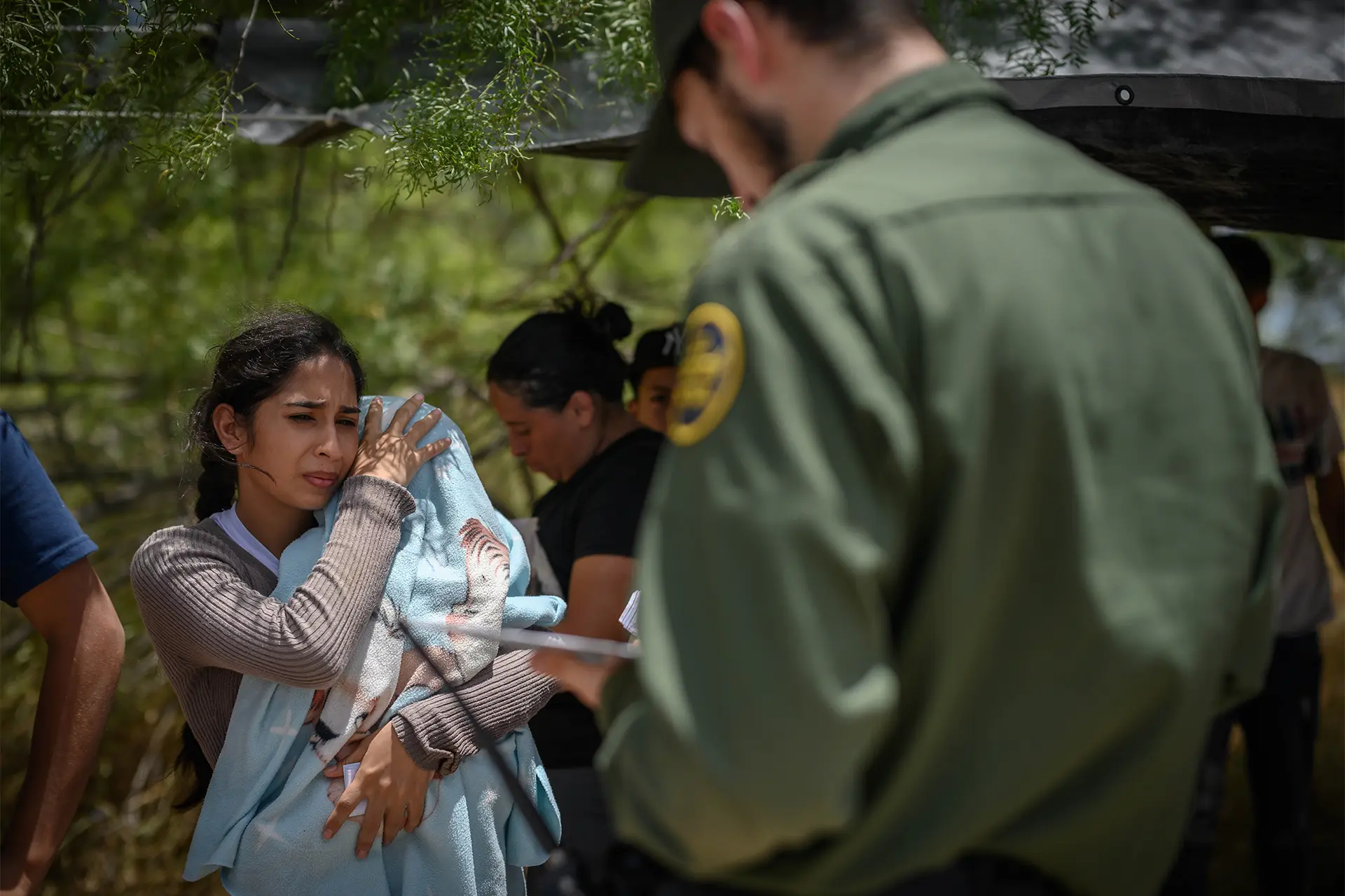
The deepest impact, however, does not always appear in official statements. It shows up in empty classrooms and forced silences. Recent reports document an increase in school absenteeism among children from migrant families, whose parents fear that leaving home could mean not returning together. Immigration policy, designed in distant offices, ends up seeping into childhood, mental health and emotional stability.
Paradoxically, while the rhetoric hardens, irregular migration has shown signs of decline. In May 2025, Border Patrol recorded fewer than 9,000 irregular crossings along the U.S. southwest border, one of the lowest figures in years. It is not that the need has disappeared; it is that the human cost of trying to migrate has become higher and more dangerous.
Even so, the undocumented population has not stopped growing. Studies by the Pew Research Center estimate that 14 million people currently live in the United States without regular immigration status, many of them long integrated into the country’s economic and social fabric. They are agricultural workers, caregivers, construction employees, parents of U.S. born and thereby citizen children.
Faced with this scenario, responses have not come only from governments. In cities such as Los Angeles, Chicago and New York, community networks have emerged to offer legal advice, food and accompaniment in the face of raids. They are small gestures against an enormous system, but they remind us that migration is not only a political phenomenon: it is a shared human experience.
International Migrants Day should not be reduced to a symbolic date or a tally of numbers. It is an opportunity to question what kind of society is built when security is imposed over dignity, when the law is applied without context, and when the migrant ceases to be a person and becomes a file.
The numbers matter. They reveal trends, pressures and effects. But faces matter more. Because behind every deportation there is an interrupted story, behind every “voluntary departure” there is a forced decision, and behind every child who misses school there is a policy that chose to look the other way.
In times of visible and invisible walls, remembering that migration is a human right — not a threat — remains, perhaps, the most urgent act of this commemoration.