
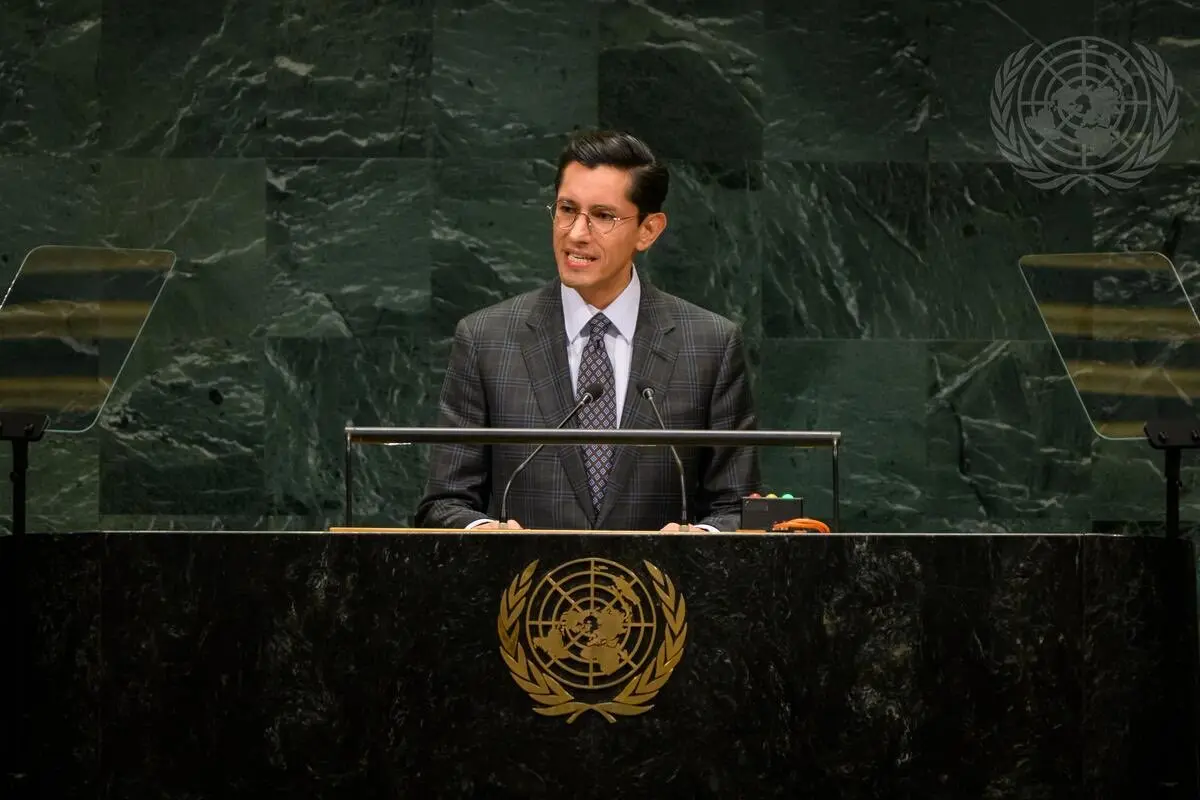
Before an international community fractured by wars, the weakening of international law and the inability of multilateral institutions to contain violence, Mexico called from the United Nations General Assembly for abandoning the logic of force and building peace based on social justice, cooperation and respect for sovereignty.
Foreign Minister Roberto Velasco Álvarez delivered that message to the 81st session of the General Assembly, held at a time of growing tensions over the war in Ukraine, the suffering of the Palestinian people and instability in the Middle East, conflicts that have once again placed the United Nations and its Security Council under pressure.
“Peace cannot be decreed or imposed; it is built with social justice,” the secretary of foreign affairs said during his address.
Velasco maintained that security cannot be achieved through the logic of war, the abandonment of human rights or the use of force as the only response, but through effective institutions and opportunities that address the root causes of violence.
Mexico argued that international law must prevail over force, civilian populations must be protected, the territorial integrity of countries must be respected and disputes must be resolved through dialogue, negotiation and peace.
The foreign minister warned that these principles cannot be applied selectively, according to political convenience or the interests of powerful nations.
“Sovereignty is not measured in armies or material resources. All nations, all peoples, have the same value before the law,” he said.
Although his address did not review every armed conflict individually, Velasco stated a direct position on Palestine by reiterating Mexico’s support for a two-State solution, its recognition of the State of Palestine and the right of its people to live in peace within secure and recognized borders.
Mexico’s position coincides with the United Nations’ call to protect civilians, guarantee access to humanitarian aid and advance toward a two-State solution amid the continuing crisis affecting Gaza and the West Bank.
Regarding Latin America and the Caribbean, Velasco said Mexico would continue working to preserve the region as a zone of peace and resolve its differences through dialogue, agreements and greater cooperation, always respecting the sovereignty and dignity of every nation.
He also reiterated Mexico’s solidarity with Cuba, its rejection of the embargo and its opposition to unilateral economic measures that violate the United Nations Charter, while assuring that the country would continue sending humanitarian aid to address the Cuban population’s most urgent needs.
The address presented diplomacy as the main instrument for preventing conflicts and keeping public resources from being devoted to destruction instead of development.
“Each conflict that diplomacy can prevent represents lives protected, communities preserved and resources that can be devoted to development rather than destruction,” he said.
Velasco said that no country can build its future in isolation and rejected the idea that international cooperation weakens sovereignty, arguing that sovereignty can be strengthened through respectful relations among peoples.
Mexico also raised the need to renew the United Nations so that it can prevent conflicts, mediate disputes and respond more effectively to global challenges.
As part of that effort, Mexico co-founded the UN80 Global Group with Norway, a cross-regional initiative seeking to promote a more effective and transparent organization, while Mexico, Qatar, Norway and Switzerland are working to strengthen its mediation capacities.
The foreign minister connected that foreign policy with Mexico’s domestic experience and used social, labor and security data to argue that lasting peace also depends on reducing inequality.
According to the figures presented by Velasco, more than 13 million people rose out of poverty between 2018 and 2024, social welfare programs reached 42.8 million people in 2026 and the minimum wage increased by 154 percent in real terms since 2018, recovering its highest purchasing power in more than four decades.
The secretary added that intentional homicides declined by approximately 51 percent during the 22 months leading up to July 2026, a result he attributed to a strategy that combines education and employment for young people with prevention, intelligence, investigation, stronger institutions and international cooperation.
The Mexican government presented the figures as evidence that social development and security can advance together under a model of cooperation based on four principles: respect for sovereignty and territorial integrity, shared but differentiated responsibility, mutual trust and cooperation without subordination.
Velasco also highlighted that Mexico is governed for the first time by a woman, Claudia Sheinbaum, accompanied by a gender-balanced cabinet and Congress, and extended that principle to the upcoming renewal of the United Nations Secretariat.
“At the United Nations, it is also time for women,” he said.
Rather than listing the wars shaking the world, Mexico brought to the General Assembly a defense of the method through which it believes they should be confronted: without double standards, without subordination among countries and without presenting force as a substitute for politics.
Related: ‘Sovereignty Is Not Negotiable,’ Sheinbaum Says as She Delivers Her Second Government Report