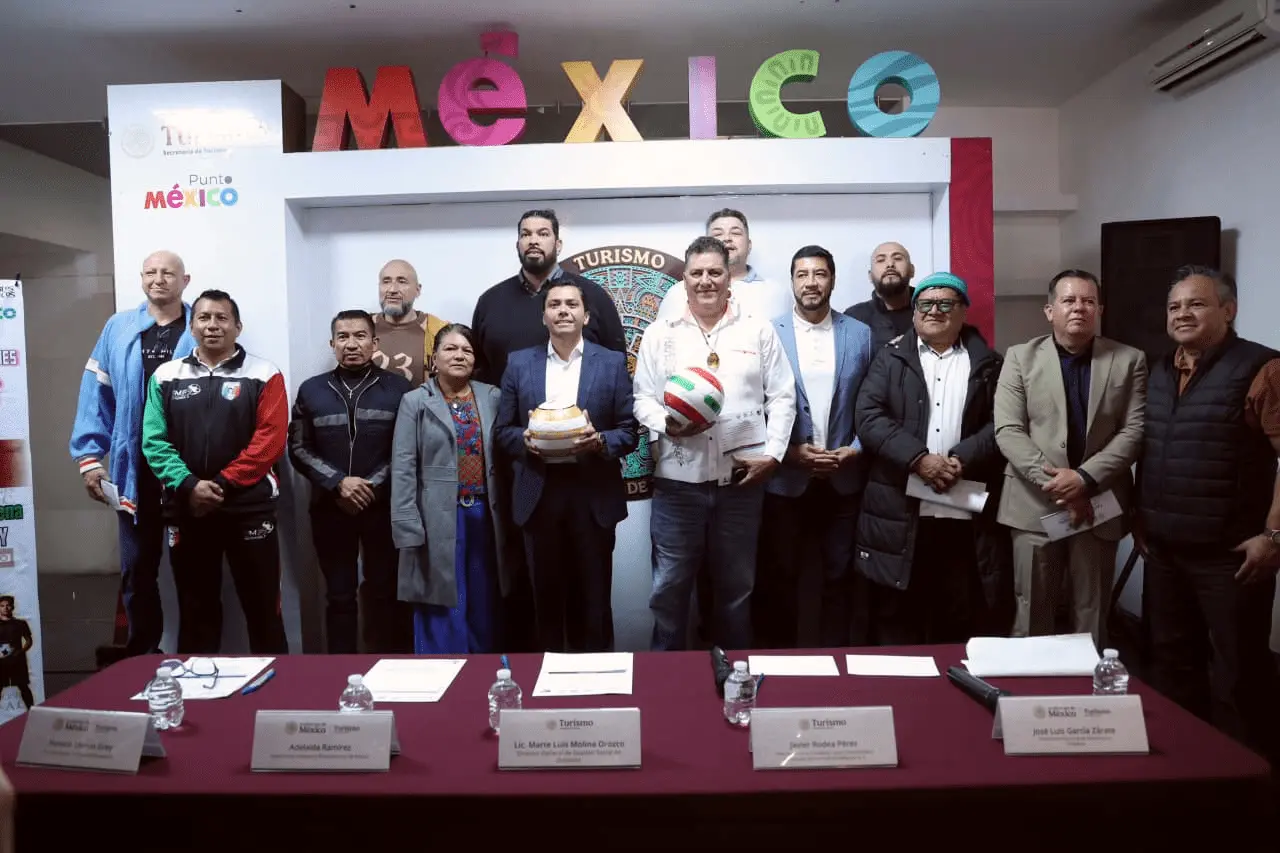
Mexico presented the 2026 National Indigenous Soccer 7 Cup and the 2026 National Indigenous Horacio Llamas Cup, two sports competitions aimed at extending the social impact of the 2026 World Cup across the entire country and strengthening the community fabric in Indigenous and Afro-Mexican communities.
Representing Josefina Rodríguez Zamora, Minister of Tourism, the Director General of Social Management of Destinations Marte Luis Molina Orozco emphasized that these competitions are part of the Mexican government’s vision to democratize access to sports and promote the benefits of the World Cup.
“By instruction of the President and Minister Josefina Rodríguez, we are working to ensure that the World Cup is experienced throughout the country. Through soccer and basketball, and from the Pueblos Mágicos we address social causes and strengthen the community fabric of girls, boys, and young people, especially those of Indigenous and Afro-Mexican descent,” he said.
State-level competitions will take place during February and March 2026 in different states across the country, with venues in various Pueblos Mágicos, as part of a strategy to consolidate sports tourism and showcase the cultural richness of Indigenous peoples. The national final will be held from April 24 to 26 in Mexico City.
The tournament will be divided into nine categories—Micro, Infantil, Pasarela, Cadete, Juvenil, Juvenil Superior, Under 21, Under 23, and First Division (Open)—with an estimated participation of around 10,000 athletes, distributed among approximately 5,000 competitors per cup. By decision of the communities themselves, teams from the general public will also be allowed to participate, as an exercise in openness and inclusion.
Adelaida Ramírez, representative of Indigenous and Afro-American Governance of Mexico, underscored the project’s social impact, explaining that “sports is a fundamental pillar for education and the country’s development. This effort represents a real benefit for children, youth, and Indigenous and Afro-American communities.”
Through these initiatives, Mexico seeks to carry the spirit of the World Cup beyond official host venues, integrating sport, tourism, and social cohesion in communities that have historically been excluded from the center of major international events.
Pueblos Mágicos is a federal tourism program created by the Mexican government to recognize towns and small cities that preserve their historical heritage, cultural traditions, natural beauty, and community identity.
The designation seeks to promote sustainable tourism, strengthen local economies, and encourage the preservation of cultural and natural assets, while offering visitors authentic experiences beyond Mexico’s major urban and beach destinations.
Related: Mazatlán Carnival 2026 Expected to Generate Over $1.2 Billion Pesos in Economic Impact