
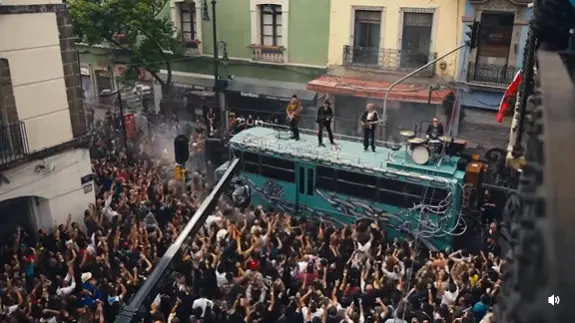
The unexpected appearance of U2 in downtown Mexico City not only sparked excitement among hundreds of Mexican fans, but also once again positioned the capital as a cultural epicenter and a global reference point for world-class artists in the lead-up to the 2026 World Cup.
The Irish band surprised audiences this week by secretly filming the music video for their new single Street of Dreams in streets near Plaza de Santo Domingo and the Palace of Medicine, using one of the most emblematic areas of the capital as their backdrop.
The shoot, kept under strict secrecy, brought together Mexican fans who had been previously invited through the band’s official website. Those selected received instructions just days before filming, initially unaware that it was a U2 production.
Images shared on social media showed Bono, The Edge, Adam Clayton, and Larry Mullen Jr. performing atop a school bus covered in graffiti by Mexican artist Chavis Mármol, while dozens of people followed the shoot through colonial buildings and closed-off streets in the historic center.
The scene evoked some of the most iconic moments in U2’s relationship with Mexico, a country where the band has maintained a deep connection since its massive concerts in the 1990s and early 2000s, including performances at Foro Sol and Estadio Azteca.
The recording also takes place at a strategic moment for Mexico City, which is preparing to host matches for the 2026 FIFA World Cup and has intensified its international positioning as a cultural, tourism, and entertainment capital.
According to information published by El País, the new U2 material may be linked to the World Cup, and there are even rumors that one of the singles could be released in connection with the international tournament.
The interest of staging international productions in Mexico City is not new, but specialists have pointed out that the momentum leading up to the World Cup has accelerated the presence of global artists, audiovisual platforms, and major productions in the city.
FIFA itself has noted that the Mexico capital will become the first city in history to host three men’s World Cups, following the 1970 and 1986 editions, reinforcing its symbolic and cultural weight on the global stage.
Beyond soccer, the city is experiencing a boom in tourism and entertainment. Data from the city’s Tourism Department show that post-pandemic recovery has once again placed the capital among the top urban destinations in Latin America, driven by concerts, festivals, and major international events.
In this context, U2’s visit appears to confirm something that both the music industry and artists themselves have long recognized: Mexico—and particularly Mexico City—has become a must-stop destination for global performances.
The emotional connection between U2 and Mexican audiences also helps explain the phenomenon. For decades, the band has maintained a particularly strong fan base in the country, where songs such as One, With or Without You, and Where the Streets Have No Name are part of the collective memory of several generations.
The reaction from fans following the filming reflected that connection. Videos and photos flooded social media as hundreds of people spontaneously gathered in the streets of the historic center hoping to catch a glimpse of the band.
Even a lightning storm that temporarily interrupted the shoot ended up adding to the narrative of the event. International media reported that the group had to take shelter in a nearby building after a power failure caused by the rain.
Beyond the filming of a music video, U2’s presence in the heart of Mexico City reinforces the image of a city that, just months before the 2026 World Cup, is seeking to establish itself not only as a sports venue but as a global cultural showcase capable of attracting the most influential figures in international entertainment.
Related: Citlali Fabián marks a milestone for Mexico by winning Photographer of the Year 2026