
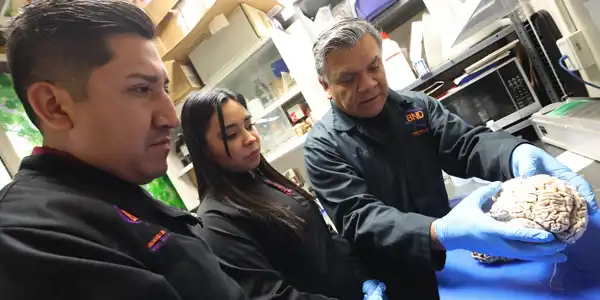
In the global race to understand Alzheimer’s, Mexican research has marked a turning point by more precisely locating the origin of brain damage and opening new possibilities to detect it in early stages through non-invasive methods from the Instituto Politécnico Nacional (IPN).
The discovery, featured on the cover of the scientific journal Brain Communications from the University of Oxford, places layer II of the entorhinal cortex of the hippocampus at the center of the debate as the point where the disease begins, a region that had remained largely unexplored.
Researcher José Luna Muñoz explained that this area serves as the gateway to the hippocampus and is the first to deteriorate, directly affecting cognitive functions. Although scientific reports had suggested since 1991 that degeneration begins in the entorhinal cortex, there were no sufficiently precise molecular tools to confirm it.

The key to the breakthrough lies in the use of the Tau 423 antibody, developed by British scientist Claude Wischik, capable of detecting early alterations of the tau protein — associated exclusively with Alzheimer’s — at stages prior to the formation of lesions visible with traditional methods.
Thanks to this marker, Mexican scientists were able to observe degenerative processes that previously went unnoticed, which explains why this region of the brain had been underestimated for decades.
The finding not only redefines the origin of the disease, it also opens the possibility of non-invasive diagnoses. The team has detected the tau protein in peripheral tissues such as blood and oral epithelia, which would allow Alzheimer’s to be identified in early stages without the need for complex or post-mortem procedures.
This advance is key in a global context where it is estimated that by 2050 more than 150 million people will be living with dementia.
In addition, researchers point out that these biomarkers could serve to evaluate the effectiveness of treatments, a challenge that currently requires long periods of clinical observation.

The project is the result of decades of scientific collaboration between the IPN, the National Biobank of Dementias, and other institutions, consolidating a line of research that seeks to move the study of Alzheimer’s from post-mortem analysis to detection in living patients.
For specialists, this development positions Mexico at the forefront of neuroscience research, while opening new possibilities to confront a disease that, although it still has no cure, could be detected and addressed much earlier than when its effects become irreversible.
Related: Mexican Scientists at IPN Develop Innovative Rapid Test to Diagnose Childhood Leukemia