The Diplomacy of the Tariff
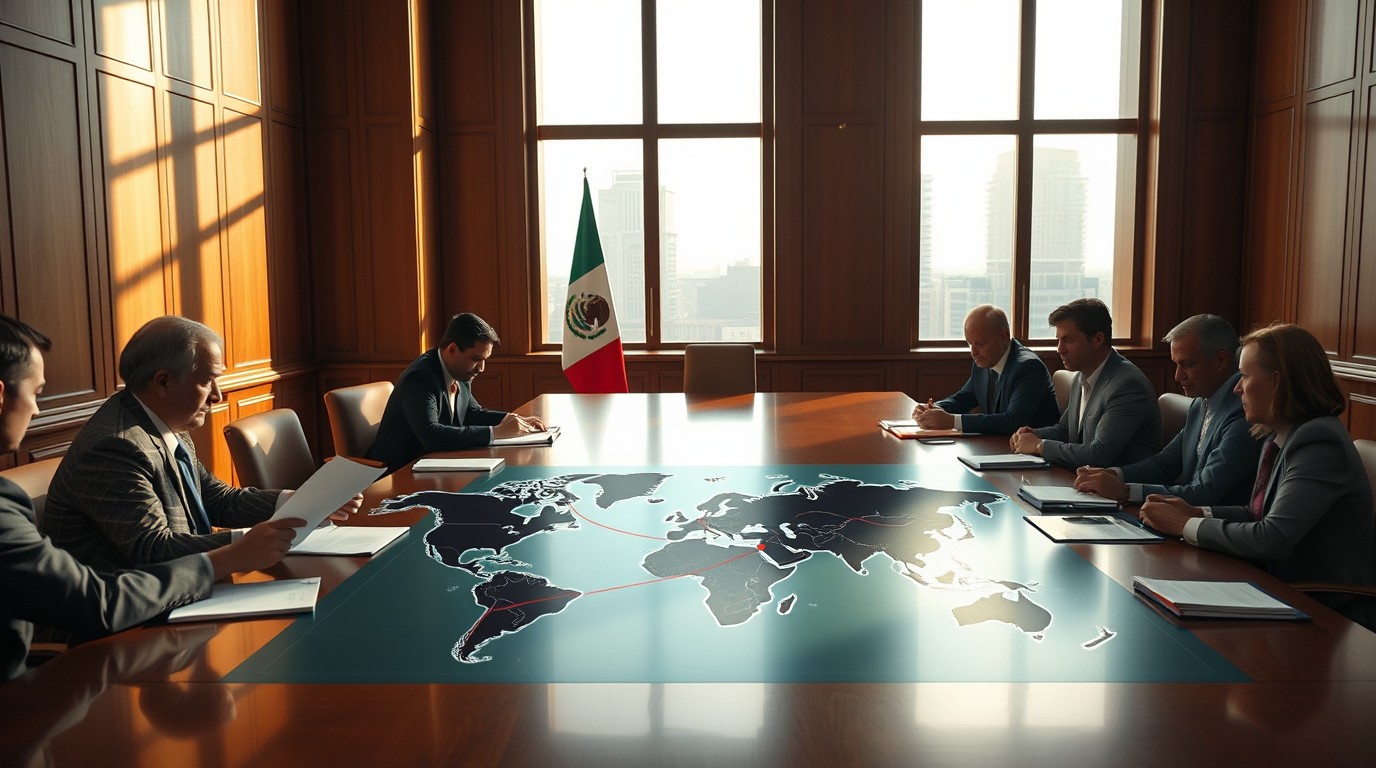
Some foreign ministers arrive to give speeches, others arrive to close chapters. Roberto Velasco belongs to the second group. He was appointed on April 1, after serving as Undersecretary for North America, in the middle of the USMCA review, and the Senate ratified him with 81 votes in favor and 30 against. His profile explains the direction: he is a negotiator before he is an ideologue, and the foreign policy he leads looks more like a negotiating table than a podium.
The formula he presented sums it up. He promised cooperation without subordination to the United States. The phrase protects sovereignty in the rhetoric, but in practice it manages interdependence. His ten-point plan explicitly includes diversifying partners and strengthening value chains. One hundred days into his tenure, the message to accredited ambassadors during the now-familiar Annual Meeting of Consuls and Ambassadors was that of a country that wants to be read as a reliable partner, with certainty about the USMCA and openness to new alliances with various regions of the world such as Europe and Asia. It is the language of an investor, not of a partisan.
Some of the facts to list are among those that accompany this discourse.
- May. Mexico and the European Union signed the Modernized Global Agreement and a Trade Agreement, the close of a process that had been under negotiation for years.
- August. Visit to South Korea with a trade component.
- September. Official visit to Beijing, China as Foreign Minister, where he also inaugurated a consulate in Chongqing.
- September. Investment Week in Mexico, in New York, where he presented an internal market of more than 130 million consumers. A foreign minister's agenda already looks a lot like an investment promoter's.
The logic is clear. Mexico exports, and most of what it exports goes to a single destination. The foreign minister himself highlighted that 87% of exports to the United States still enter under the rules of the treaty. But on July 1, in the first joint review, the United States decided not to renew the USMCA in its current form, although the agreement remains in force, while Mexico and Canada had expressed their intention to extend it 16 years.
With that uncertainty open, every agreement with Europe, every consulate in Asia and every investment tour reduces exposure to a single partner that is reluctant to keep playing under the same rules and seeks to change them.
While this new era of a Mexico has a diplomatic dynamism centered and concentrated on economic diplomacy, which almost exclusively speaks the language of trade and gains credibility with the markets, there are examples where it loses it in other, broader areas of international relations.
When Velasco defended the government against the UN's observations on disappearances, arguing that the resolutions had political motivations, critics saw exactly that cost: the priority of being a predictable partner leaves little room to be an uncomfortable interlocutor. A pragmatic foreign policy does not have to be a merely executing policy, but it requires ensuring that trade does not become its only argument.
It remains for us to suggest that tightening the trade ties now being woven with Europe and Asia are stones of a broader strategy to build real autonomy in the face of a complex future in the bilateral trade relationship on which our country depends most.
More from Economy
All stories →
AT&T and Telefónica exits leave Mexico's mobile market to Televisa and Telcel
AT&T sells its Mexican unit to Televisa and Fintech for $2 billion after Telefónica's exit, leaving Telcel and Televisa atop Mexico's mobile market in 2026.

Forward Look 2030: The Targets Mexico Will Use to Measure Its Progress
The fifth chapter of the report charts the route to 2030. Shared Prosperity, the guiding axis of the 2025-2030 National Development Plan, rests on four principles: substantive equality, economic inclusion, productive sustainability and institutional cohesion.
Mexico's Four National Plans: Infrastructure, Energy, Security and Water
The fourth chapter groups public investment into four national plans, each with measurable targets, accountable owners and a budget. In infrastructure, the plan invests more than 960 billion pesos in 2026, roughly 52 billion dollars, in transport links, ports, airports, trains, energy, hospitals and schools.