Mexico Has More Than One North: Sheinbaum Widens the Table Ahead of Her Meeting with Trump
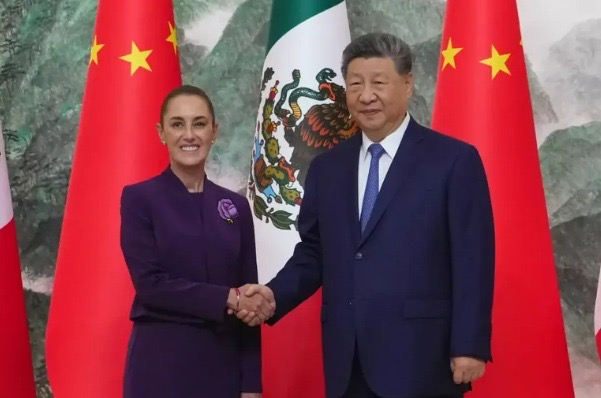
Before Claudia Sheinbaum greets Donald Trump in China, it is worth dismantling an idea that tends to be imposed from Washington: that Mexico must prove its loyalty to the United States every time it talks with another country; the relationship with China is not a provocation, and Mexican diplomacy has no reason to ask permission to open more doors.
Sheinbaum has already met with Xi Jinping, with whom she discussed cooperation in technology, science, agriculture, water, health and tourism, and she described her visit as "very productive"; the agenda shows that Mexico can seek opportunities in Asia without giving up its trade ties with North America.
She also met with Canadian Prime Minister Mark Carney to review the bilateral action plan and reaffirm trade cooperation between the two countries; the meeting matters because defending the USMCA and the trilateral relationship is fundamental to the economies of Mexico, Canada and the United States.
With Trump, by contrast, Sheinbaum anticipates a "very very brief, bilateral, a greeting" encounter; that brevity should not be read as weakness or as a failed negotiation, but for what it is: a contact within the framework of an international summit, insufficient to resolve the trade and political tensions between the two countries.
Caution makes sense before a president who has used the threat of tariffs to pressure Mexico, including on migration issues; a relationship between partners cannot rest on ultimatums, and dialogue does not oblige Mexico to accept that Washington dictates whom the Mexican government may talk to.
Mexico has reasons to protect its relationship with the United States, its main trading partner, and also to broaden its ties with China, Canada and other Asia-Pacific economies; diversifying does not mean breaking alliances, but rather preventing the country's future from depending on a single door.
Sheinbaum's agenda in Shenzhen includes meetings with representatives of Vietnam, Australia and Singapore, as well as a meeting with the managing director of the International Monetary Fund, while Mexico prepares to host APEC in 2028; the country is not attending the summit as a spectator, but as an economy seeking to take part in the region's decisions and opportunities.
Trump will get a brief greeting; Mexico, by contrast, needs to sustain a foreign policy with more than one interlocutor and a single compass: defending its interests, its sovereignty and the well-being of its people.
More from Opinion
All stories →
'Mexico Embraces You' and Isabela’s Miracle
The “Mexico Embraces You” strategy and the “Bienestar Paisano Card” represent a success of the current administration.

November 4: When Trumpism Began to Crumble
On November 4, the United States experienced a political jolt that few in the White House — not even in the gilded mansion of Mar-a-Lago — expected.

The Super Bowl: A Luxury and a Political Statement for Mexicans
Attending Super Bowl LX is not just about witnessing the most-watched sporting event on the planet—it is about crossing a symbolic border between spectacle, economy, and politics.