Sheinbaum Announces Dates for the Reopening of Border to Livestock
President Claudia Sheinbaum confirmed that an initial agreement has been reached to reopen the U.S. border for Mexican cattle exports.
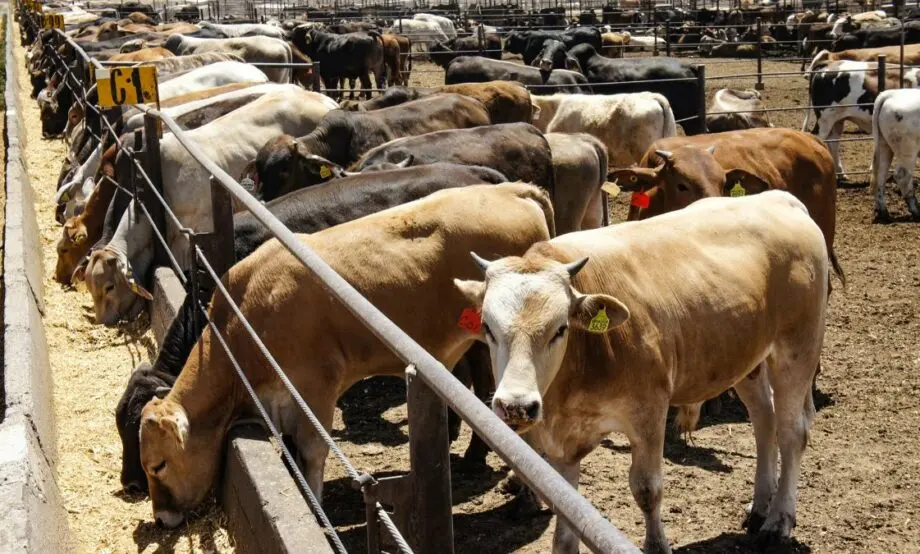
The President highlighted the agreement to reopen the U.S. border to Mexican cattle on July 7, though working groups are still ongoing.
By Once Noticias. Mexican Press Agency.
President Claudia Sheinbaum confirmed that an initial agreement has been reached to reopen the U.S. border for Mexican cattle exports.
During the “Mañanera del Pueblo” press conference, the President outlined the dates and locations where border crossings will resume.
“Yesterday, we reached a preliminary agreement with the U.S. Department of Agriculture. Working groups are still in progress to expedite the full reopening, but for now, the Agua Prieta, Sonora border crossing will reopen on July 7; Puerto Palomas, Chihuahua on July 14; San Jerónimo, Chihuahua on July 21; Acuña, Coahuila on August 18; and Colombia, Nuevo
León on September 15,” the President reported.
She clarified that the Mexican government is continuing to work with Washington to reopen the Nogales, Sonora export point and to speed up the process overall.
Sheinbaum noted that the U.S. Department of Agriculture’s reasoning is that “they want to reopen gradually to monitor the situation with the screwworm,” to which the Mexican agency has “repeatedly emphasized that this pest is contained and currently only found in specific areas of the country’s south, far from the northern border.”
Agreement Between Mexico and the United States
Yesterday, Mexico’s Ministry of Agriculture and Rural Development (SADER) announced that a phased reopening of the border for live cattle exports had been agreed upon with the United States, starting July 7.
In an official statement, the SADER reported that the decision followed a virtual meeting between Mexico’s Minister of
Agriculture, Julio Berdegué Sacristán, and his U.S. counterpart, Brooke Rollins, Secretary of Agriculture. The agreement was based on a favorable U.S. assessment of Mexico’s strategy to control and eradicate the cattle screwworm (CSW).
It was also announced that on July 1, a bilateral technical meeting would take place between the U.S. Animal and Plant Health Inspection Service (APHIS) and Mexico’s National Service for Agri-Food Health, Safety and Quality (SENASICA) to follow up on the agreement.
Related: Mexican Breaks Guinness Record for Fastest Open Water Swim Around Manhattan
More from Economy
All stories →
Mexico's Four National Plans: Infrastructure, Energy, Security and Water
The fourth chapter groups public investment into four national plans, each with measurable targets, accountable owners and a budget. In infrastructure, the plan invests more than 960 billion pesos in 2026, roughly 52 billion dollars, in transport links, ports, airports, trains, energy, hospitals and schools.

Social development: pensions, hospitals, scholarships and housing as rights
The third chapter of the report argues that social policy has stopped being a complement and become the structural axis of growth. By the end of 2026, the Wellbeing Programs will reach 42,860,296 people, with an investment of close to one trillion pesos, about 54 billion dollars, delivered directly through the Wellbeing Card.
Economy and Investment: Stable Prices, Formal Employment and Industrial Hubs Looking Toward North America
The economic chapter of the Second Report brings together price stability, formal employment, investment and regional development. Gross domestic product grew 1.4% in the second quarter of 2026 compared with the previous quarter…